Sichuan makes us ask a curious question.
Can a colour restore a person?
After a week on its roads and three days in Chengdu, every time we drove through Sichuan something in us has shifted. The battery is charged again.
Can green be a feeling?
We have eaten too much hotpot, stayed out in bars much later than intended, looked across grasslands that seem to continue beyond the curvature of the earth, and spent long hours on roads where the next interruption might be a yak, a monk, a coppersmith, a woman looking for a lift, or simply a view that makes continuing feel slightly absurd.
Perhaps it is the color. The green. Sichuan green, do you know that colour?


Chengdu may be the cooler Shanghai
To us, Chengdu feels like Shanghai after it has loosened its collar and decided to stay out for one more drink.
It is unmistakably metropolitan, self assured and sophisticated, yet remarkably relaxed about it. People dress well without appearing to have dressed for an audience. Cafés remain busy into the evening. Bars appear behind discreet doors, inside converted houses and above streets filled with the steam of hotpot restaurants.
For our taste, Chengdu has the best bar scene in China. It has invention without theatre, elegance without stiffness and enough curiosity to turn one drink into a very long evening.
During the day, hotpot seems to be everywhere. Its scent escapes from doorways, hovers above pavements and settles into clothes. In another part of the city, Shuijingfang still makes baijiu around ancient fermentation pits hidden within the modern metropolis. Few cities carry their appetite and their history quite so openly.
And then there are the pandas.
Classic tourist attractions rarely determine our journeys. The first time we went to see Chengdu’s pandas, we cried on the way there.


This surprised us almost as much as the animals themselves.
You quickly understand that Chengdu’s obsession with pandas reaches far beyond clever merchandising. The city speaks about them with the warmth normally reserved for eccentric relatives. They seem to belong to the civic family.
Then the road begins to climb
Leave Chengdu westwards and the land quickly rises from the Sichuan Basin towards western Sichuan and the Tibetan highlands of Kham.
The green changes as we climb. Eventually, it reaches the horizon and stays there. The distances become difficult to measure.
Yaks and horses graze beside black tents. Eagles ride the thermals. Even vultures gather near the road with the severe patience of creatures that have learned to wait. Herbalists search the slopes for plants that will later pass through the hands of traders, pharmacies and traditional doctors.
A snow leopard may be somewhere in those mountains. Seeing one would require extraordinary luck. Knowing that it could be there already changes the landscape.


The people we meet across Kham share Tibetan culture, language and religion with communities further west. In our experience, encounters often unfold more easily here than in the Tibet Autonomous Region. Conversations begin beside the road, over butter tea, in a monastery courtyard or in one of the small restaurants that become precious after several hours of driving.
The culture feels deeply rooted and very much alive.
Villages compete in devotion
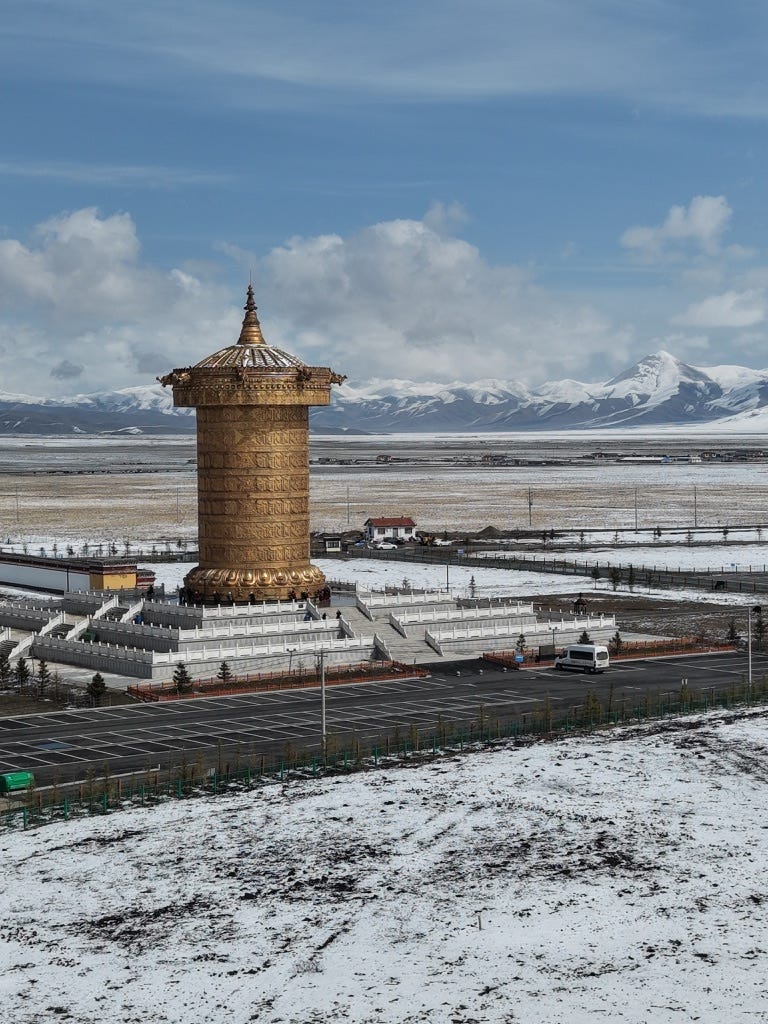
Driving across western Sichuan, we sometimes wonder whether the villages are engaged in a kind of competition over who can build the largest prayer wheel.
These are no modest objects that turn gently in a temple corner. Some rise twenty five metres or more into the sky, monumental cylinders of colour, scripture and devotion that require several people to set them in motion.
The architecture around them changes from valley to valley. Some houses are radiant white, others earthy brown. Their windows carry intricate frames painted in deep reds, yellows, blues and greens. The proportions are generous, the walls solid, the courtyards protected from the wind.
Local history, available materials and different traditions of Tibetan Buddhism have left their traces. We repeatedly try to decide which style we find most beautiful. The decision rarely survives the next valley.
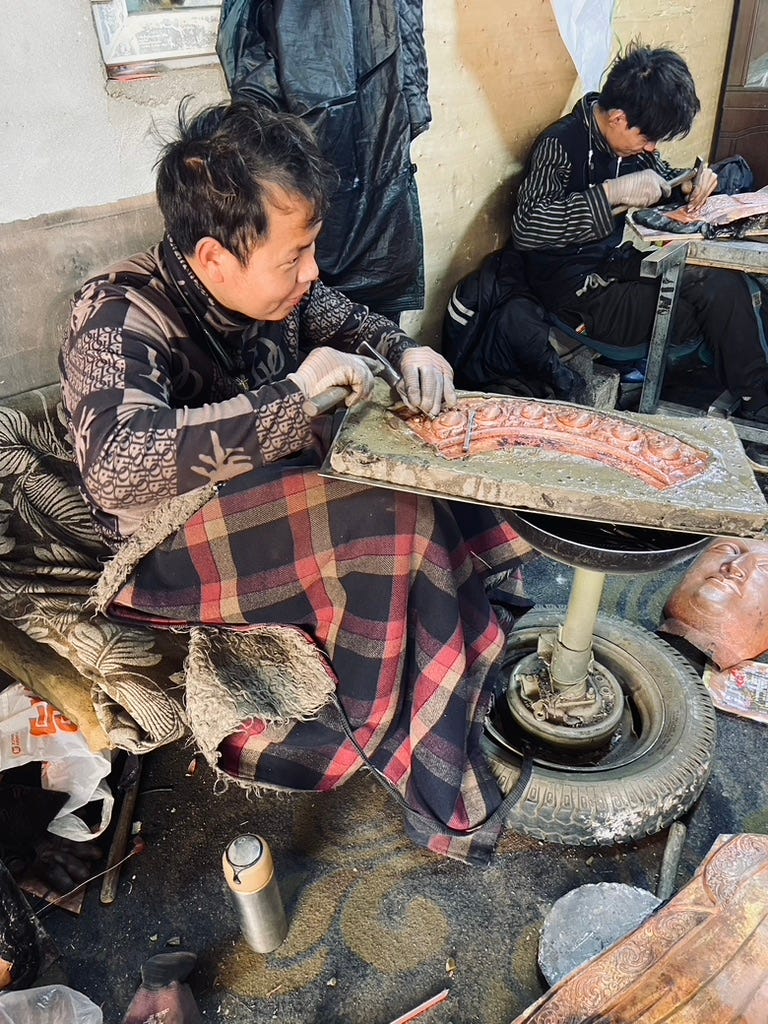
In one settlement, we meet a coppersmith working on a new figure for a nearby monastery. The sculpture is still incomplete, its face emerging slowly beneath his hands. There is no performance arranged for visitors. He is working because the monastery needs a figure and because this is his craft.
Those moments stay with us longer than many famous sights.
Where the road becomes public transport
On the more remote roads, regular public transport gradually disappears. The road itself becomes a social institution.
People wait beside it and raise a hand when a car approaches. Whenever it feels right, we stop.
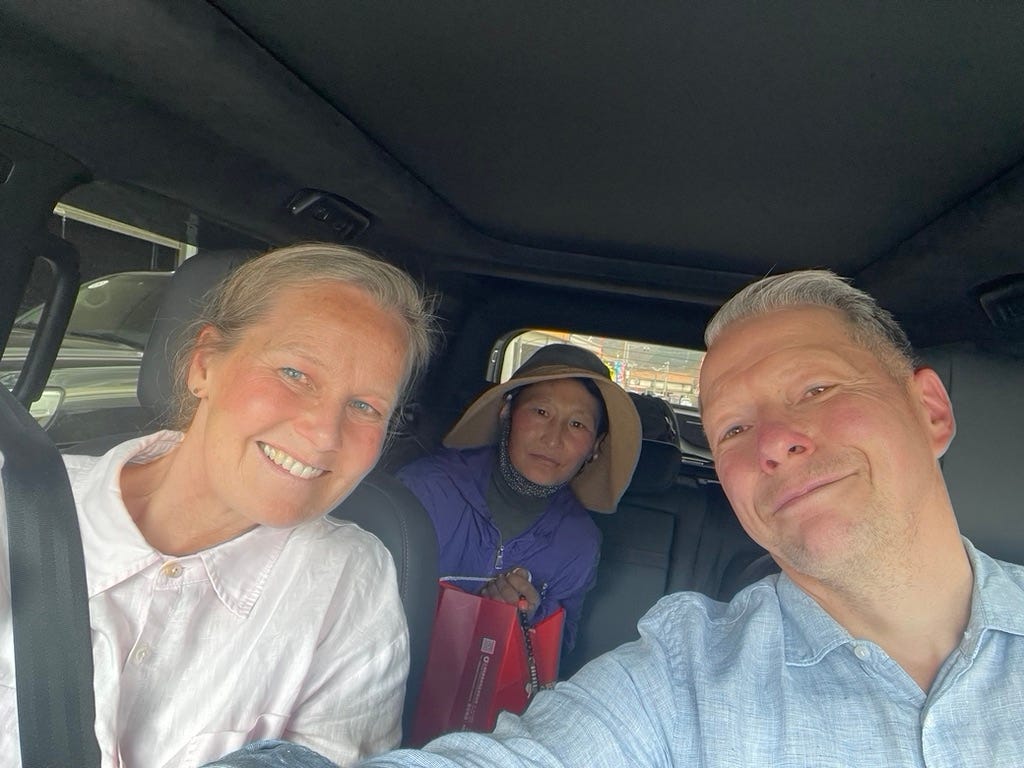
A farmer may need to reach the next village. Someone has finished at a local market and wants to get home. They climb in, settle among our bags and we try begin to talk.
On Sunday afternoon, you will see children trying to hitch a ride towards a town with a suitable school. They were standing beside the motorway with their bags, but we kept driving. As foreigners, the situation felt too uncertain. Adult passengers are easy. Children bring a responsibility that cannot be solved through goodwill alone.
Road travel is filled with such small ethical decisions. It brings freedom and intimacy, together with the obligation to pay attention.
Luxury begins when the horizon has no audience
Western Sichuan contains some of the quietest landscapes we know, along with some remarkably ambitious hotels.
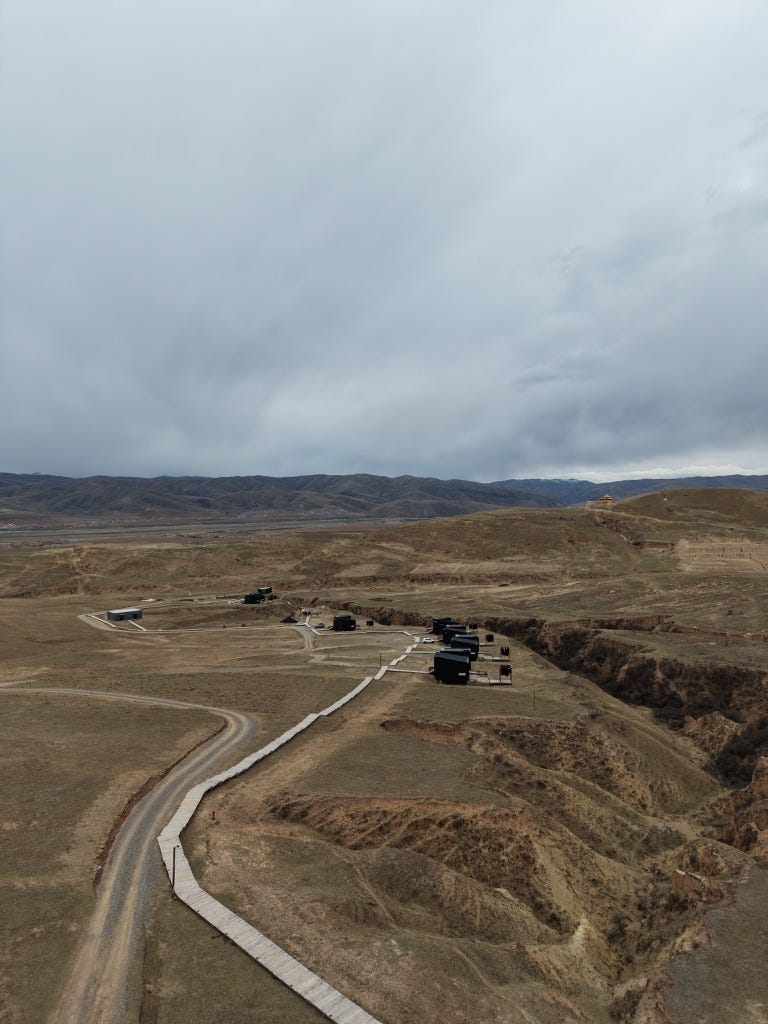
After hours on empty roads, you may arrive at a hotel complex whose industrial design would attract attention in New York. Here, it stands almost alone on the edge of the grassland, facing a mountain that has needed no architect.
The real luxury is the silence.
You eat breakfast while looking towards a peak rising more than six thousand metres into the morning light. By afternoon, someone serves coffee beside a cake shaped like the snow mountain visible through the window.
Many of these mountains are sacred. Others remain unclimbed because they are remote, technically difficult or simply overlooked, too many.
The rarity of human encounters gives them weight. A herder on horseback, a monk walking between villages or a family gathering medicinal plants becomes part of the memory of the landscape.
The distances are so immense that staging an encounter for passing visitors would rarely make economic sense. The herbalist collects herbs because there is a market for them. The coppersmith works because a monastery needs his art. The farmer asks for a lift because the road leads home.
Life belongs to the people who live here. Travellers are briefly allowed to observe it.
Perhaps that is the rarest form of luxury.
A province of whisky, Buddhas and rockets
Sichuan resists every attempt to reduce it to a single image.
Near Mount Emei, a modern whisky distillery is creating a Chinese interpretation of malt whisky through local barley, water and oak. Nearby, the Leshan Giant Buddha has watched the meeting of three rivers for more than a thousand years.
Further south, the province changes character again. Near Xichang lies one of China’s major satellite launch centres. With fortunate timing, a journey through Sichuan can include the sight of a rocket rising above the mountains.
Few places place contemplative monasteries, new whisky, giant Buddhas and space technology within one provincial border and make the combination feel entirely plausible.
Then there is E’ya.
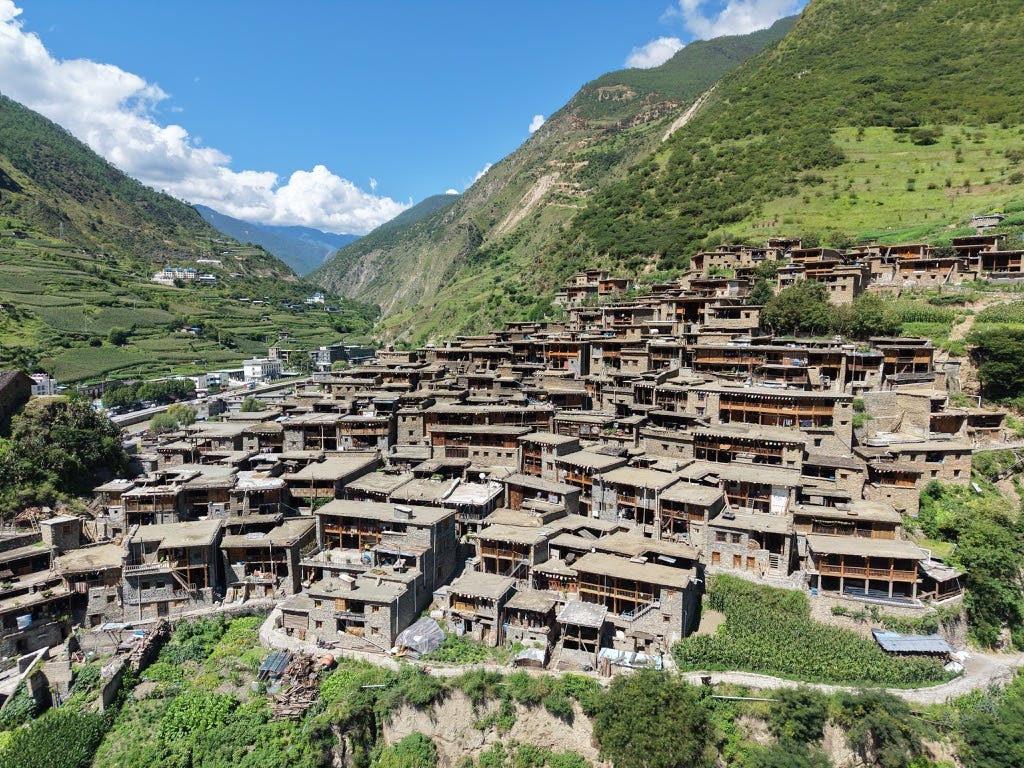
The road to this remote Naxi township is demanding enough to act as a filter. People here still speak about family traditions in which a woman may have more than one husband, arrangements that grew from the economic and social realities of isolated mountain life.
By the time we arrive, we have the distinct feeling that foreign visitors remain unusual.
The effort of reaching E’ya changes the encounter. Remote places should ask something of the traveller. Easy access has its virtues. Difficulty preserves attention.
Some landscapes refuse to be consumed
Sichuan is too large to be completed.
Every road appears to suggest another. Every valley contains a turn we have yet to take. Behind the famous mountains are quieter mountains. Beyond the monasteries that appear in guidebooks are smaller monasteries reached by roads without signs.
This is a province where we can spend days trekking and meet only a handful of people, then return to Chengdu and enter a bar that would hold its own in London, Tokyo or New York.
After a week in Sichuan and three days in Chengdu, your internal tank is full again.
Why?
Perhaps green lowers the pulse. Perhaps distance restores proportion. Perhaps an open horizon reminds us that the world remains larger than the routines through which we usually understand it.
The green begins it.
The space deepens it.
The encounters make it stay.